Material · Leather
Leather in the bag: gloves, belts and straps
One hide, three jobs. The glove takes the most handling, the belt the least, and the strap sits in between.
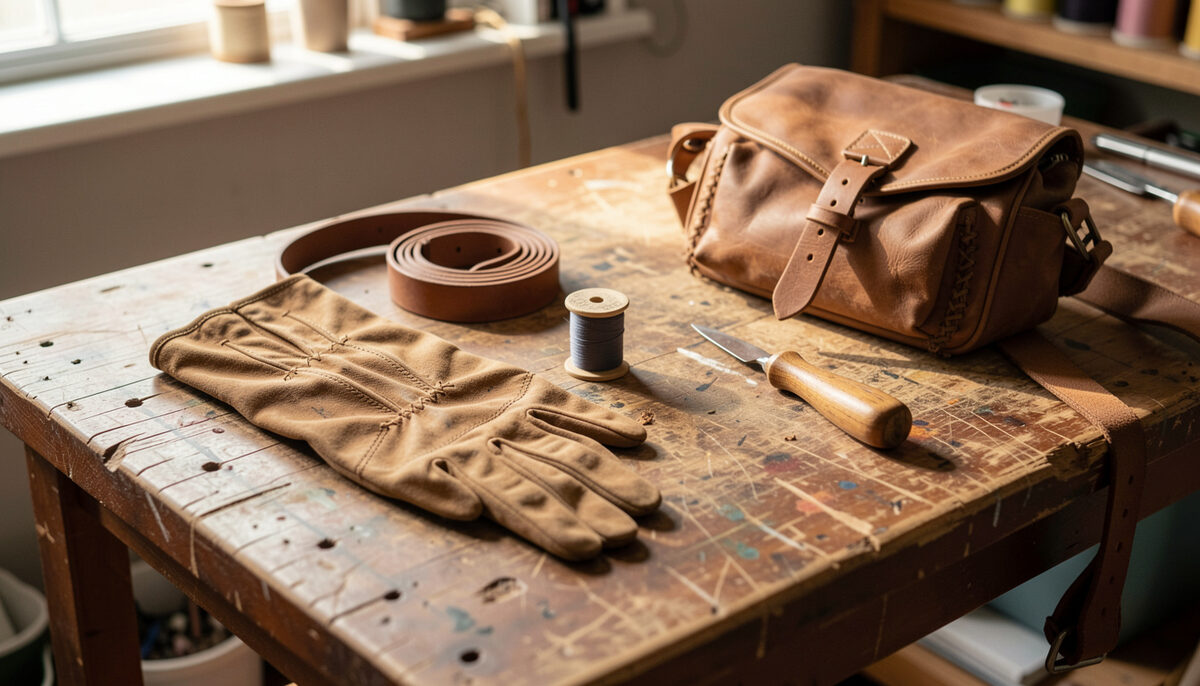
Leather is the oldest material in a golfer's bag, and the one that ages most visibly. A glove darkens in weeks, a belt softens over years, and a bag strap wears a groove where the shoulder meets the pad. Understanding why each piece wears differently starts with the part of the hide it was cut from and the way it was tanned.
Cabretta: the glove leather
Cabretta is a lightweight, chrome-tanned sheepskin that has been the standard glove leather for decades. It comes from hair sheep, animals raised for wool and meat rather than pelts, and the grain is tight enough to hold a thin cut without tearing. A single cabretta hide yields roughly forty to sixty glove panels, and the best gloves use panels from the back of the skin, where the fibre structure is densest.
The chrome tanning process gives cabretta its characteristic softness and stretch. A glove must conform to the hand within a few rounds, which means the leather needs to yield without going limp. Manufacturers balance this by splitting the hide to a precise thickness, usually between 0.5 and 0.7 millimetres, and then drum-dyeing it so colour penetrates the full cross-section. Surface-dyed cabretta will show pale patches wherever the grip rubs through, which is why most quality gloves are drum-dyed.
The main wear pattern on a cabretta glove appears on the palm where the club handle sits. A right-handed player wears the left glove, and the pressure points cluster at the base of the fingers and the heel of the palm. A golfer who grips firmly will see the leather thin and polish smooth within fifteen to twenty rounds. A lighter grip extends glove life to forty rounds or more. Humidity matters too: cabretta absorbs moisture, and a damp glove stretches faster than a dry one, losing its fit before the leather itself fails.
Belt hide: thicker, slower to change
Golf belts are cut from a different part of the animal and processed differently. Most leather golf belts use full-grain cowhide, split to around three millimetres and finished with a light surface coat. The hide is firmer than cabretta because a belt must resist the torsion of a swing without stretching out of shape. A belt that elongates even a few millimetres will shift during the backswing, which is why belt leather is chosen for stability rather than softness.
The construction of a golf belt also differs from a dress belt. A dress belt typically sandwiches a filler between a face and a backing, which can delaminate over time. A good golf belt is a single strip of leather, edge-painted and stitched only at the buckle attachment. The buckle itself is usually a removable prong-and-post style, secured with a screw post rather than a rivet, so the buckle can be swapped when the leather is still sound.
Wear on a belt concentrates at the holes. Each time the prong engages, it compresses the fibres around the hole edge, and over a season the most-used hole will oval slightly. A golfer who plays in the same pair of trousers every round wears one hole faster than someone who rotates between fits. Conditioning the belt once a month with a light leather cream slows this process by keeping the fibres supple, but the hole that gets used every day will always age first.
Bag straps: load-bearing leather
The shoulder strap on a carry bag or a staff bag carries a different kind of stress. A loaded golf bag weighs between ten and fifteen kilograms, and that weight sits on one shoulder for four or five hours. The strap leather must be thick enough to distribute the load without cutting into the collarbone, yet flexible enough to wrap around the shoulder contour.
Most bag straps use cowhide split to four or five millimetres, often backed with a closed-cell foam pad that does the actual cushioning. The leather in this case is partly structural and partly cosmetic, it holds the pad in place and takes the abrasion from being set down on cart paths, bunker edges and wet grass. The underside of the strap, where it meets the shoulder, usually has a suede or rough-out finish for grip, since smooth leather slides on a polo shirt in humid conditions.
The attachment points are where straps fail first. The stitching that connects the strap to the bag frame bears the full weight every time the bag is lifted, and thread wears faster than leather. Inspect these junctions at the start of each season. If the thread is fraying or pulling through the leather, a repair while the leather is still sound costs a fraction of a replacement strap.
Care across the three leathers
Each leather needs a different routine. Cabretta gloves should be laid flat to dry after a round, never placed on a radiator or in direct sun, heat dries the chrome-tanned fibres and makes them brittle. A light application of glove-specific conditioner every few weeks keeps the leather supple, but over-conditioning softens it too much and accelerates stretch.
Belts benefit from a monthly wipe with a damp cloth followed by a thin coat of leather cream. Store the belt rolled rather than folded, which prevents creases from setting. If the belt gets wet during a round, let it dry at room temperature before putting it away; storing damp leather invites mildew, which shows as dark spots that will not brush out.
Bag straps need the least attention but benefit from an annual clean. A saddle soap application removes embedded grit from the surface, and a conditioner rubbed into the edges, where the leather is exposed and most prone to drying, extends the life of the strap well beyond the bag itself. For more on material-specific routines, gear care by material covers the full shelf.
The common thread across all three leathers is that drying is the enemy. Leather that dries slowly, at room temperature, retains its fibre structure. Leather that is force-dried loses the oils that keep it flexible, and once those oils are gone, cracking follows within a season. The material rewards patience more than any other in the bag. What that drying discipline shares with the sharpening bench of an ice sport is read in what edges ask across sports.
Leather gloves, belts and carry straps share one weakness: moisture left in the fibre. A wet hide swells, then dries stiff and cracks along the seams, so the same care that keeps a strap supple applies to any working animal and its gear. The parallel is not exact, but readers who follow working dogs will find the same logic of preparation and handling in this guide to classes from Started to Open, which sets out the phases of a sheepdog trial, how judges score them, and what a first run asks of handler, dog and sheep.