Rubric · Majors
Major championship gear, read like a rail
Four days, one wardrobe rulebook. What a major week asks of cloth, collars and shoes.
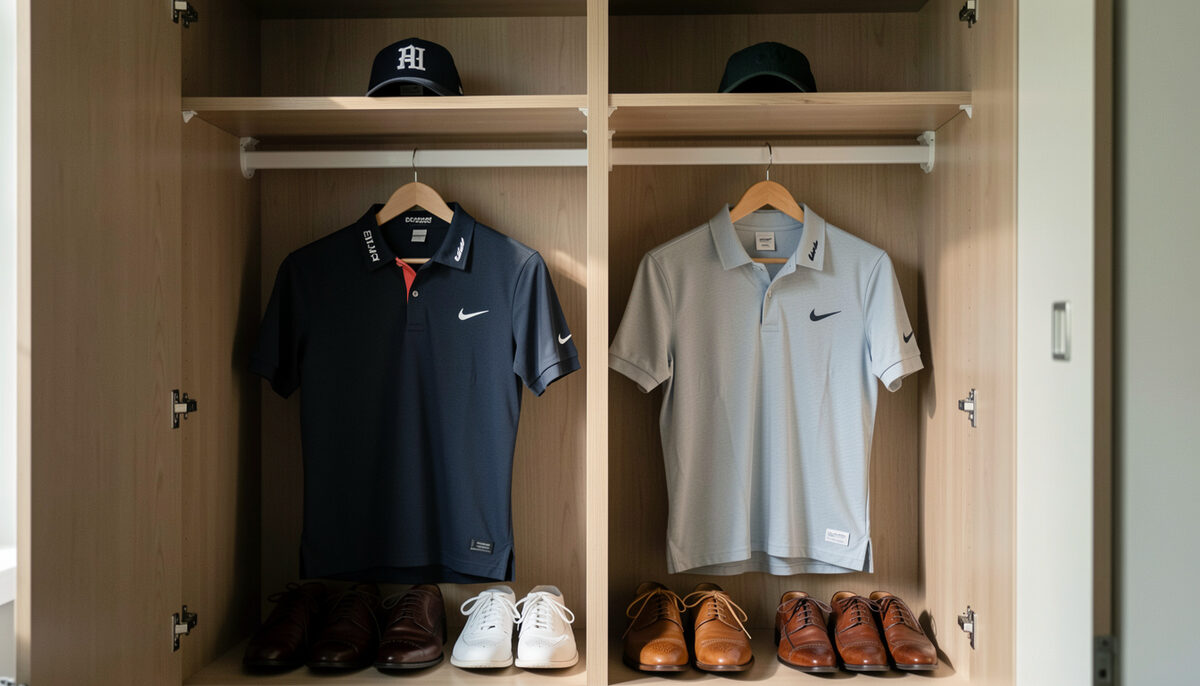
A major championship week is unlike any other week on the golf calendar. The field is larger, the rounds are longer in elapsed time, and the attention to what a player wears is magnified by broadcast cameras, sponsor obligations and the sheer number of hours spent on the property from Monday walkthrough to Sunday evening handshake. The wardrobe that survives four competitive rounds has to meet demands that a regular tour stop simply does not impose.
The walkthrough and the rehearsal
Monday and Tuesday at a major are working days in every sense. Players walk the course with their caddie, charting greens, testing bunkers and rehearsing recovery shots from places they hope never to visit during competition. The clothing for these days is functional above all else. Lightweight performance polos, unlined shorts or trousers with stretch panels, and shoes that can handle six or seven miles of walking on terrain that has been softened by course preparation watering. A player will often go through two pairs of socks during a walkthrough day, not because of wear but because morning dew and irrigated rough leave the feet damp long before lunch.
The rehearsal round is also where new equipment gets its last honest look. A driver that arrived from the manufacturer on Sunday evening will be hit off a dozen different lies. A putter swap will be tested on the practice green until the player either commits or shelves it. The clothing, meanwhile, is simply the quiet backdrop to all of that decision-making. Nothing should draw attention to itself. Nothing should restrict a full shoulder turn on a practice swing from a buried lie in fescue.
Pro-am day and the sponsor layer
Wednesday at a major is pro-am day, and it introduces a wardrobe layer that does not exist at a standard event. Players are paired with amateurs who have paid substantial sums for the experience, and the clothing on display carries the weight of those commercial relationships. This is the day when the branded polo, the logo on the sleeve, the coordinated colour story between hat and shirt, all matter more than at any other point in the week. Teams will have prepared pro-am outfits that balance the player's comfort with the sponsor's visibility requirements, and these outfits are typically set aside from the competition wardrobe entirely.
Shoes for pro-am day tend toward the more traditional end of the spectrum. Leather uppers are common because the walking pace is slower, the photographer presence is heavier, and the images will circulate in sponsor materials for months. A shoe that photographs cleanly against the backdrop of a major championship venue matters on this day in a way it does not on a Thursday morning tee time.
Competition days: Thursday through Sunday
The four competition rounds demand clothing that performs under conditions that change hour by hour. Early morning tee times in cool air give way to afternoon heat. A player who tees off at seven in the morning on Thursday will finish their round in conditions that may be twenty degrees warmer and significantly more humid. The fabric has to manage that transition without clinging, bunching, or losing its shape on camera.
Collars are a small but important detail. Tournament regulations at major championships typically enforce a collared shirt requirement more strictly than a regular tour stop, and the collar itself must hold its shape through four hours of play, practice green visits, and the walk from the eighteenth green to the scoring tent. A collar that wilts or curls by the back nine looks tired on television, and players notice.
Trousers and shorts follow venue tradition. The Masters enforces a no-shorts policy for competitors throughout the week. The US Open and the Open Championship permit shorts in practice rounds but expect trousers or tailored shorts of a specific length during competition. The PGA Championship is generally the most flexible, but the expectation is that whatever is worn looks intentional and consistent across all four days.
The shoe rotation across four rounds
No serious competitor wears the same pair of shoes for all four rounds of a major. The foot needs recovery time, and so does the shoe itself. Leather uppers need to dry out between rounds. Spikeless soles accumulate course debris that alters traction if not cleaned. Most players rotate between two or three pairs across the week, choosing based on the conditions they expect for that day's round. A wet morning might call for a spiked shoe with aggressive traction. A dry afternoon on firm ground favours a spikeless design with a wider base for stability during the swing.
The shoe bag is a piece of kit in itself. It holds the rotation, the spare laces, the brush, and often a small tin of leather conditioner for traditional uppers. It travels with the tournament bag every day of the week and is one of the first things a player reaches for when they arrive at the clubhouse on Thursday morning.
The Sunday layer and the television finish
Sunday at a major is the day when clothing choices are most scrutinised. The final round is broadcast in full, and the player in contention is on camera for four or five hours without interruption. The Sunday outfit is typically the one the player feels most confident in, the one that has been broken in during earlier rounds, the one where the fit is exactly right. Many players wear the same colour on Sunday that they wore on Thursday, a small superstition that connects the start of the tournament to its conclusion.
The outer layer matters on Sunday too. A leaderboard contender walking to the eighteenth tee in fading light or gathering wind may pull on a lightweight quarter-zip or a wind vest, and that garment needs to match the rest of the outfit closely enough that it does not look like an afterthought on the trophy presentation. The teams that prepare a player's major wardrobe think about this. The Sunday layer is planned, packed, and ready, even if the weather forecast says it will never be needed.
Four rounds in the same outfit rules ask more of a body than of a wardrobe: heat, walking and a fixed schedule of early starts. The preparation that keeps a player steady across a championship week is the same preparation covered in the note on strength work after fifty, which sets out how long a run must be for weight loss, what the 12-5-30 treadmill protocol does to energy expenditure, whether incline walking burns as many calories as running, and strength work for people over fifty. Cloth can be chosen on the Thursday; condition is built in the months before.
A major championship week asks one outfit to hold its shape across four rounds, and the body inside it carries the same load. Cloth is measured in fibre, weight and rating; the person is measured in hours. The two scales meet in the recovery window between rounds, where sleep and movement decide how the next morning feels. For readers who want the figures rather than the folklore, the numbers behind sleep and movement gathers institutional sources on weekly movement, blood pressure and blood sugar, alongside hand hygiene, vaccines and food labels.