Rubric · Ryder Cup
Ryder Cup attire, the uniform of the week
One week where clothing is decided by committee: colours, singles day outfits and the ritual of dressing alike.
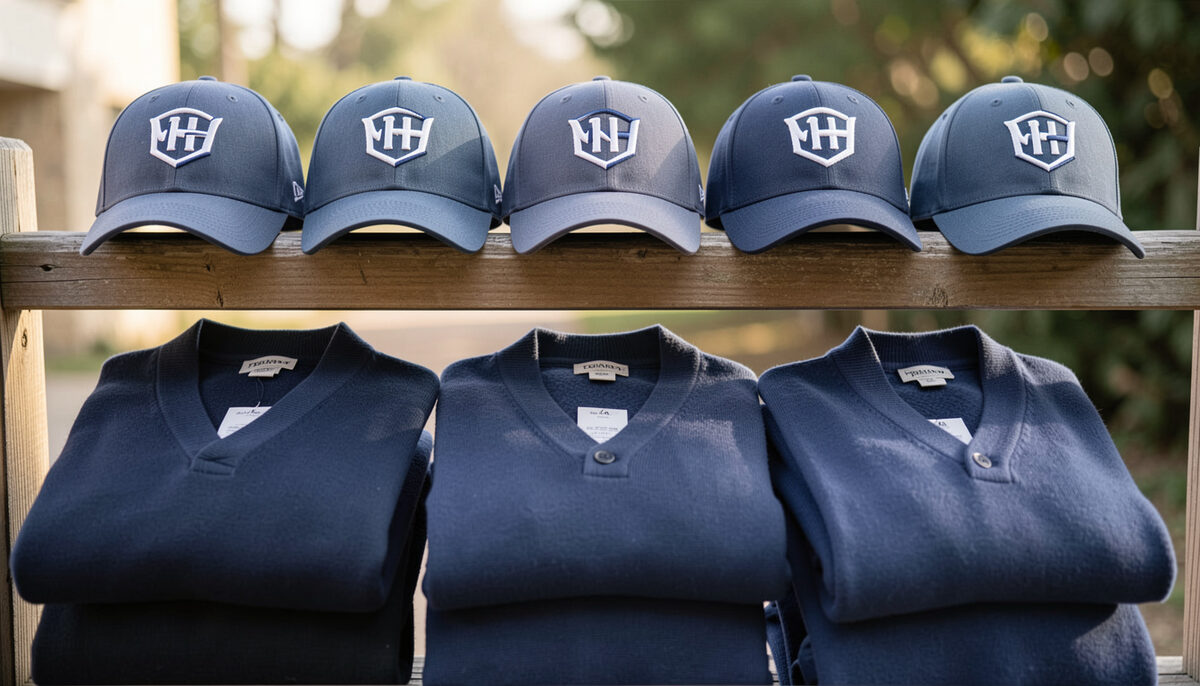
The Ryder Cup is the only week in professional golf where clothing is decided not by the player but by the team. A captain, a styling committee, and the apparel sponsor collaborate weeks in advance to produce a coordinated wardrobe that communicates identity, unity and intent. For the twelve players on each side, the week is less about personal expression and more about wearing what has been chosen for them, and wearing it in a way that looks effortless on camera from Wednesday opening ceremony to Sunday singles handshake.
Team colour and the identity question
The first decision in any Ryder Cup wardrobe is colour. The European team and the United States team each select a palette that will define their side for the entire week. These colours are not chosen lightly. They must photograph well against the host course backdrop, reproduce accurately across broadcast and print media, and carry enough contrast that the two teams are instantly distinguishable on screen even in wide crowd shots. A host venue with dense green tree lines will push teams toward bolder colours. A links course in muted autumn tones allows more subtlety.
Once the palette is set, it cascades through every garment the team wears. Practice round polos, opening ceremony jackets, on-course shirts, caps, shoes, socks, even the towel draped over a caddie's shoulder all carry the team colour somewhere in their design. The effect is deliberate. When twelve players walk onto the first tee together on Friday morning, the visual impact of coordinated colour is one of the most powerful images in the sport. It communicates something that individual tournament golf never can: that these twelve men are one unit, playing for something larger than themselves.
The opening ceremony outfit
The opening ceremony is a formal moment dressed in semi-formal clothing. Teams typically arrive in a tailored jacket or blazer, a collared shirt worn without a tie, and trousers that bridge the gap between smart and comfortable. This outfit is photographed extensively and is often the first image the public associates with that year's team. It has to look good in a group photograph of twelve players standing shoulder to shoulder, which means the tailoring has to accommodate a wide range of body types while maintaining a consistent silhouette.
Shoes for the opening ceremony are almost always leather. Loafers, derbies, or clean sneakers in a neutral colour that complements the team palette. The ground at the ceremony venue may be grass, gravel, or a mix, so sole choice matters. A smooth leather sole is elegant but treacherous on damp grass. A rubber cup sole is practical but may look too casual in photographs. The styling team will have considered this, and the shoes issued to the team will reflect the specific surface the ceremony will take place on.
Friday and Saturday: the team sessions
The fourball and foursomes sessions on Friday and Saturday are where the team wardrobe does its hardest work. Players are on course for four to five hours, often in pairs, and the coordinated look between partners is a visual reinforcement of the partnership itself. Partners will wear matching or complementary shirts, and their caddies will carry towels and wear caps in the same team colour. The effect from the fairway is of two people operating as one, which is exactly the message the format demands.
Layering becomes important across these two days because Ryder Cup venues are often in northern latitudes where September weather is unpredictable. A morning foursomes session might begin in cold wind and finish in warm sunshine. Players need a mid-layer that matches the team palette and can be removed without disrupting the outfit underneath. Quarter-zip pullovers, lightweight vests, and performance cardigans are all standard issue for a Ryder Cup team wardrobe, and each piece is designed to layer cleanly over the competition polo without adding bulk around the shoulders.
Sunday singles: the individual statement within the uniform
Sunday singles is the one session where the team uniform loosens slightly. Players still wear the team colours, but there is more room for personal preference in the details. A player might choose a different collar style, a different fit in the trouser, or a different shoe from the team-issued options. The captain and styling team allow this because singles is ultimately an individual contest, and a player who feels comfortable in what they are wearing will perform better than one who feels constrained.
The Sunday outfit is also the one most likely to be remembered. If a player holes the winning putt, the shirt they are wearing becomes part of Ryder Cup history. Captains know this, and they will often save a special design element for Sunday. A different shade within the team palette, a subtle pattern that was not used on Friday or Saturday, or a garment with a meaningful detail inside the collar or on the sleeve. These small touches give the Sunday singles outfit a weight that goes beyond fabric and stitching.
What the dressing ritual says about the match
There is a ritual to dressing for the Ryder Cup that has no equivalent in individual golf. Players arrive at the team room each morning and change together. They put on the same shirt, the same cap, the same colours as the man next to them. For players accustomed to choosing their own wardrobe and managing their own brand, this surrender of individual choice is both unfamiliar and powerful. It signals that the week belongs to the team, not to any single player. The clothing is the first thing that makes that signal visible, before a ball is struck and before a shot is played. The uniform of the week is not just fabric. It is the opening statement of a team that intends to win together.
A team week works because twelve players agree on one kit in advance and wear it the same way, day after day. The same logic holds for a daily bicycle commute, where the variables are rain, cold, heat and traffic rather than a scorecard. The tested kit list on the commuter page covers layers, lights and quiet route planning, and it sets out the thirty day riding challenge, a month of repeated rides that shows what an employer has to provide. Read it as the counterpart to this page: one uniform for a week, one kit for every working day.
A team week works because twelve players agree on one set of garments months ahead, then wear it the same way on every morning of the matches. The same logic of preparation holds in other sports where equipment is fixed by rule rather than by taste. A class 8 kite buggy is built to a FISLY specification, and its pilot runs a fixed sequence of checks before a session: wing start and relaunch, crossing and overtaking on a marked course. The page sets out that specification and the routine, item by item, in the same way this page sets out a uniform.