Material · Soles
Soles and spikes, read from below
Turn the shoe over and the whole argument is visible: spikes, lugs, and the ground they were shaped for.
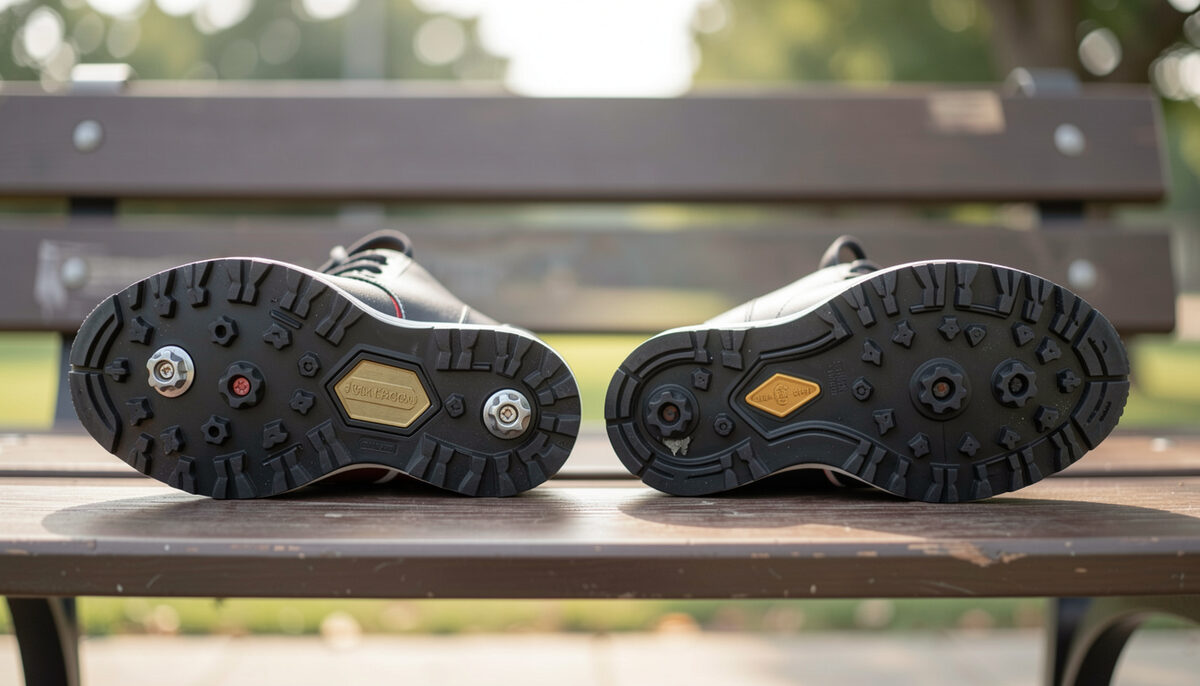
Turn a golf shoe over and the outsole tells you what the shoe was designed for. A spiked sole with seven or eight screw-in cleats is built for soft ground and aggressive weight transfer during the swing. A spikeless sole covered in small rubber lugs is built for comfort and versatility, accepting less traction in exchange for a shoe you can wear off the course. Between those two poles, every detail, lug shape, spike placement, midsole compound, reflects a decision about what ground the shoe will be used on and how hard the player pushes against it.
Spiked outsoles: cleats and their geometry
Traditional spiked golf shoes use removable cleats that screw into threaded receptacles moulded into the outsole. The cleats themselves are usually made from a hard thermoplastic polyurethane with a metal insert for the screw thread. Modern cleats have between five and eight prongs radiating from a central hub, and the prong shape varies, pointed prongs penetrate soft turf more aggressively, while flat-topped prongs distribute pressure more evenly and are less damaging to greens.
Cleat placement is not arbitrary. Most designs place three or four cleats under the forefoot, where ground pressure peaks during the downswing, and two or three under the heel. The lateral side often has an additional cleat to resist the outward roll of the foot. A shoe with fewer cleats is lighter but provides less resistance to lateral slide, which matters most on wet or sloping lies.
Cleat wear shows as rounding of the prong edges. A fresh cleat bites into turf; a worn cleat glides over the surface. Most players should replace cleats every fifteen to twenty rounds, though sandy soil dulls them faster than soft loam. Replacement is straightforward with a cleat wrench. The full range of spiked and spikeless shoes is compared across the shoes aisle.
Spikeless outsoles: the lug pattern
Spikeless golf shoes have no removable cleats. Instead, the outsole is moulded with a pattern of rubber lugs, raised protrusions that grip the ground through friction and deformation rather than penetration. The lug pattern varies widely between manufacturers, but the most common shapes are circular, hexagonal and blade-like, each with different behaviour on different surfaces.
Circular lugs provide multi-directional grip and work well on firm ground, where they can deform slightly to increase contact area. Hexagonal lugs offer more edges to catch on turf and are common on shoes designed for mixed conditions. Blade lugs, which are elongated and oriented in a specific direction, provide the most aggressive grip in the direction perpendicular to the blade, ideal for resisting lateral slide during the swing, but offer less grip in other directions. Some manufacturers combine lug types on the same outsole, placing blade lugs under the forefoot for swing stability and circular lugs under the heel for walking comfort.
The rubber compound of the outsole matters as much as the lug shape. A harder compound lasts longer but grips less on wet surfaces. A softer compound grips better but wears faster, especially on paved cart paths and hardpan. Most spikeless shoes use a compromise compound in the mid-range, which provides acceptable durability and grip but does not excel at either. Players who walk the course on soft ground will wear through a spikeless outsole in two to three seasons; players who ride in a cart and play on firm courses may get four or five seasons from the same sole.
The midsole: what sits between the ground and the foot
Between the outsole and the insole, the midsole absorbs impact and controls foot movement. Golf shoe midsoles are typically ethylene-vinyl acetate, a lightweight foam, or polyurethane, a denser and more durable foam. EVA is softer and lighter but compresses over time, losing cushioning after roughly one hundred rounds. Polyurethane is firmer but maintains its properties for much longer, which is why it appears in shoes for frequent walkers.
The midsole also affects stability. A thicker midsole cushions more but raises the foot, reducing the sense of connection to the turf. A thinner midsole brings the foot closer for better feel but sacrifices cushioning on hard surfaces. Tournament shoes tend toward thinner midsoles; walking shoes trend thicker. Some manufacturers use a dual-density midsole, firmer laterally for swing stability and softer medially for comfort.
Soft ground and the case for spikes
The argument between spiked and spikeless shoes resolves quickly when the ground is wet. On soft, saturated turf, a spikeless lug pattern cannot penetrate deeply enough to resist lateral slide, and the player will feel the foot move during the downswing, a loss of stability that costs distance and accuracy. A spiked shoe with fresh cleats penetrates through the soft surface to the firmer soil below, anchoring the foot regardless of how wet the top layer is.
This is why most competitive players keep a pair of spiked shoes for wet conditions and a pair of spikeless shoes for dry days. The spiked pair gives up comfort, hard cleats transmit more ground shock, but provides the traction a wet round demands. The spikeless pair handles dry conditions and is more comfortable to walk in.
Shoe uppers also differ between the two types. Spiked shoes typically have leather or synthetic leather uppers that resist water and support the foot during aggressive weight transfer. Spikeless shoes often use lighter materials, including mesh panels, which improve ventilation but offer less support. The choice of sole type therefore drives the choice of upper, and the shoe as a whole reflects the conditions it was designed for.
Neither type is universally better. The right sole depends on the ground, the weather, and the way the player moves through the swing. Reading the outsole, its lugs, its cleats, the rubber it is made from, is the fastest way to understand what a shoe will do when the ground is soft and the shot matters.
Outsole design follows the same rule that governs every sport: the surface decides the build. Golf asks for spikes, spikeless rubber or hybrid lugs because the swing needs grip on turf, sand or a damp fairway. Football splits the same question differently, and korki and halowki explained sets out how studded and moulded soles answer grass and hard pitches, alongside running shoes for asphalt and trekking boots for mountain paths. Read the two pages together and the pattern holds: identify the ground first, then choose the sole, the lug depth and the upper that suits it.