Rubric · Scoring
The scorecard, the pencil and the marker, read as gear
The cheapest equipment on the course is the equipment that records it. What the card, the pencil and the marker decide.
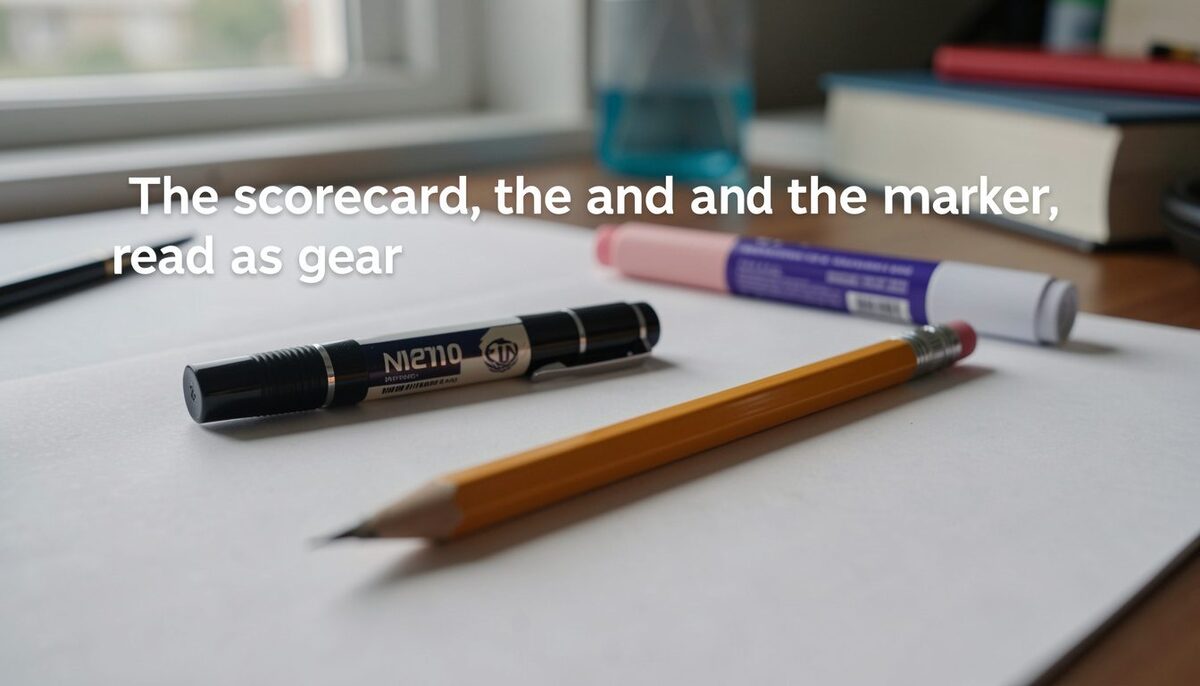
The bag holds fourteen clubs and a pocket of small things, and the smallest of them decide what the round is worth. The scorecard is a folded sheet of printed card, the pencil is a stub with no eraser, and the marker is a coin or a flat disc the size of a thumbnail. Together they cost less than a single ball, yet they carry the only record a competition recognises. On the accessories rail of this review they count as gear in their own right: the accessories aisle ranges the pocket kit they ride with, and the card is the piece the whole kit is packed around.
How do you read par and index before you tee off?
Reading the card before the round is a piece of equipment preparation, as much as wiping a grip or checking a cleat. The printed row of par figures says what each hole is built to yield: a par three playing to a raised green, a par five bending around water, the sequence of par fours where the score is actually made. Beside each hole sits a second number, the index, and the two columns together describe the course before a ball is struck. A player who reads both on the first tee knows where the round is hard on paper, where it is generous, and which holes a handicap gives back. For golfers who read Dutch, golf rules explained in Dutch on Op de Baan walks through the scorekaart itself, the WHS handicap with its course rating and slope, and the play situations a card cannot answer, each one tagged with the number of the rule that governs it.
What does the index column on a scorecard actually mean?
The index column is the hole's rank in the handicap system. Index one is the hole where a stroke is most likely needed, index eighteen the least, and a player receiving handicap strokes collects them on the holes in index order. A player off eighteen receives one stroke on every hole; a player off nine receives one on the nine hardest by index. The numbers are set by the club or the rating authority from measured difficulty, not from par, which is why a short par three can carry a lower index than a long par four everyone expects to be the test of the day.
The index matters beyond nett scoring. In match play it decides where strokes are given and taken, which changes how a hole is played from the tee. In stableford it decides which holes still convert a bogey into points and which demand a par. Even in a casual round it tells a group where a conceded putt costs someone a hole they were owed. The card is doing arithmetic before the round begins, and the pencil records whether the arithmetic held.
The pencil, the marker and the card as gear
The pencil on a scorecard is usually a short stub, cut down so it fits the clip on the trolley or the loop inside the bag pocket. It writes in every weather, which is its one job, and the card is printed on a coated stock so the graphite holds and the sheet survives a damp pocket. Courses hand out both free at the counter; the gear answer is the dedicated version, a pencil with a proper clip or a card holder of leather or plastic that keeps the sheet flat and legible through eighteen holes of being opened, written on and folded back.
The marker is the smallest piece of all and the most regulated. On the green a ball is lifted only behind a mark, and the marker that makes it has to be small, flat and placed directly behind the ball. A coin does it; the dedicated answer is a flat metal or plastic disc, sometimes carried on a divot tool or a hat clip so it cannot be lost in a deep pocket. The club championship kit counts two markers as a minimum for a weekend, because a marker dropped in long grass is gone and a ball lifted unmarked costs a stroke. The brushes and edges that keep the rest of the bag honest get their own reading in the edge care entry.
Why does the cheapest gear on the course decide so much of the score?
Because the score exists only as far as the card records it. A hole played in four and written as a four is a four; a hole played in four and signed for a three is a lower score than was made, and in competition the signed card, not the memory of the round, is the record. The Rules of Golf published by the R&A set the player's duty plainly: hole scores checked, handicaps shown, the card returned and signed. Get the equipment of recording wrong and the round that was played stops existing.
That is why this kit earns a shelf of its own. The card reads the course before it is played, the pencil answers it as the round goes, and the marker holds a line on the green so the ball can come back to the exact spot it left. None of them swings, none of them flies, and together they decide more of what a round is worth than most of what fills the bag.
A pencil and a marker sit at the bottom of the bag by weight and by price, yet they belong to a wider class of small gear that decides how a round is recorded and remembered. The same logic holds away from the course: a scorecard, a board and a screen all ask someone to keep count in public. Dutch screens: classics, darts, cafe football follows that thread through a spring of televised racing and darts months, an evening of Champions League football in a cafe, and the 501 rules at the cafe, where the board in the corner keeps its own score.