Rubric · Club championship
Club championship kit: a weekend packed once
Thirty six holes in two days. What goes in the bag, what stays in the car, and the spare that saves a round.
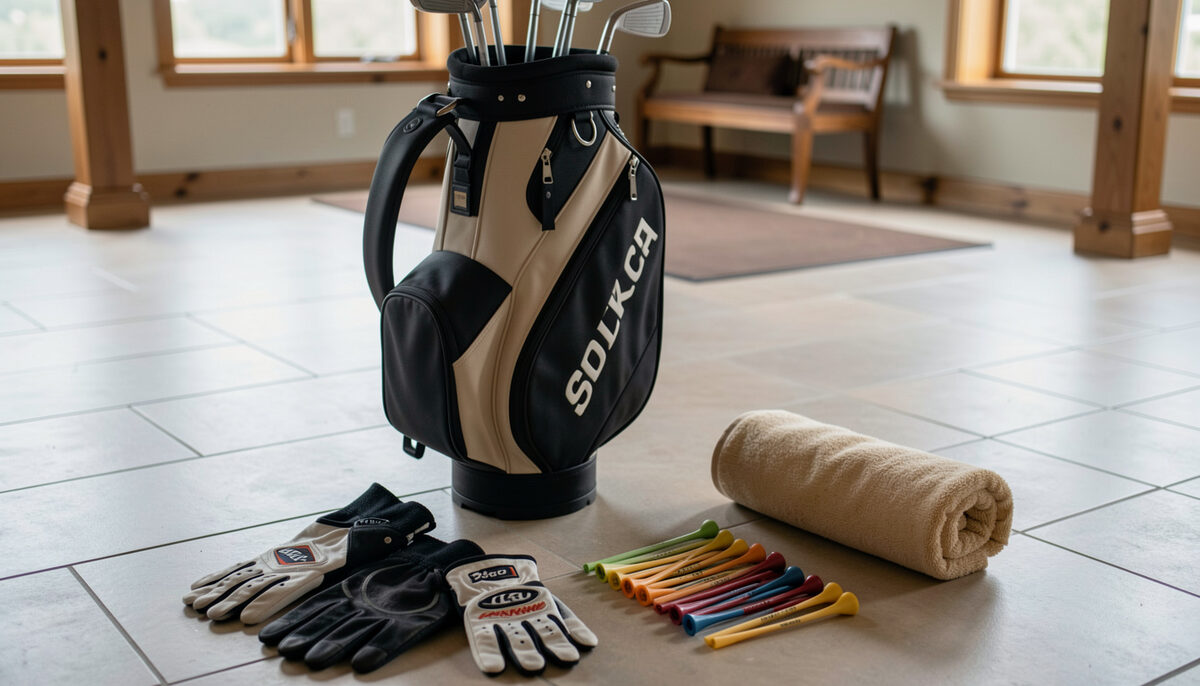
The club championship is the most important weekend of the year at any golf club, and it asks for a specific kind of preparation. Thirty-six holes across two days means that everything in the bag has to last, perform, and be accounted for before the first tee shot on Saturday morning. There is no pro shop to visit at the turn if you have forgotten a glove. There is no caddie to send back to the locker room for a spare. What you pack is what you play with, and the difference between a well-packed bag and a poorly packed one often reveals itself on the back nine of Sunday when fatigue and weather conspire to test every piece of kit you brought.
The clothing rotation for thirty-six holes
Two days of competition means two complete outfits, plus reserves. The Saturday shirt should be the one you feel most comfortable in, the one that has been worn and washed enough to be soft but still holds its collar through four hours of play. Sunday's shirt is a fresh one, broken in during a practice round earlier in the week but saved for the final round. Bringing a third shirt is not excessive. Afternoon rain, a cart path splash, or a bunker shot that fills the back of the shirt with sand can make a change necessary mid-round, and a club championship is not the place to play the last six holes in a soaked polo because you did not pack a spare.
Trousers follow the same logic. Two pairs minimum, one for each day, with a lightweight waterproof overtrouser in the bag if the forecast is uncertain. Shorts are fine if the club allows them, but many club championships have a trouser requirement, particularly on Sunday. Check the competition notice before you pack, not after you arrive.
The glove count and the small leather goods
Gloves are the single most common point of failure in a club championship bag. A player who practises on the range before their round and then plays eighteen holes will put significant wear on a single glove. Over two days, with a practice session each morning, four gloves is a reasonable minimum. Five is better. A glove that has lost its tack on Saturday morning can cost a shot on a wet par-three, and a torn glove on Sunday afternoon has no remedy if there is no spare in the bag.
The same principle applies to shoes. One pair is acceptable if the weather is dry and the forecast is clear. Two pairs is wise if there is any chance of rain, because a wet shoe does not dry overnight in a hotel room or a car boot, and starting Sunday in damp shoes is a distraction that affects balance and confidence from the very first tee shot. If you bring two pairs, bring two sets of spare socks as well. A fresh sock in a damp shoe buys comfort for at least nine holes.
The towel situation
Every serious competitor in a club championship should carry two towels. One is the primary towel, clipped to the bag and used for cleaning clubfaces between shots. The second is a larger drying towel, kept in a side pocket or draped over the umbrella tube, reserved for drying hands, grips, and the ball on the tee when conditions are wet. A single towel becomes saturated on a wet day and loses its usefulness by the twelfth hole. Two towels rotate: one in use, one drying on the bag frame during the walk between holes.
The material matters as much as the quantity. A waffle-weave towel cleans clubfaces better than a standard terry cloth because the texture lifts dirt from the grooves. A microfiber towel dries hands and grips faster because the material absorbs more water relative to its weight. The ideal setup is one waffle-weave towel for clubfaces and one microfiber towel for everything else, with a third towel in the car as a complete emergency replacement if both on-course towels become waterlogged.
The small kit: tees, ball markers, repair tools
The small items in a club championship bag are easy to overlook and expensive to forget. Tees should be counted before the round: a minimum of fifteen for a competitive eighteen-hole round, because broken tees are common on courses with tight fairway mowing and a low tee height preference. Ball markers should be carried in a dedicated pocket, not loose in a trouser pocket where they can fall out during a bunker shot. Two markers minimum, because a dropped marker on a green is lost in the grass more often than expected. The card this kit exists to fill, and the pencil that fills it, are read on their own shelf in the scorecard and pencil entry.
A divot repair tool, a groove cleaner, and a small brush for the clubface round out the essential small kit. These items weigh almost nothing, take up minimal space, and each one addresses a specific problem that arises during a competitive round. A groove clogged with mud from a fairway bunker shot affects spin on the next approach. A ball mark on the green that is not repaired properly affects the line of a putt three groups later. The player who carries these tools and uses them is the player who has thought about what thirty-six holes actually requires. What a groove brush shares with a skate stone, and the drying and sharpening intervals behind both, is ranged in the care of edges across sports.
A weekend packed once is one problem, and a season packed twice a week is another: the bag that has to open and close from spring to autumn is read in the league play kit, where rotation, drying and spares are counted across a calendar.
What stays in the car and why
A club championship bag is not a packing exercise in bringing everything. It is equally about knowing what to leave behind. Rain gear stays in the car unless the forecast is active, because carrying a waterproof jacket in the bag on a dry day adds weight and shifts the bag balance on the shoulder. A second umbrella is unnecessary if the first is in good condition. Practice balls for the range should be left in the car and collected only on the way to the practice ground, not carried on the course. The bag that goes to the first tee should contain only what the next four hours demand. Everything else is a short walk away, and the discipline of packing light for the round while packing fully for the weekend is the mark of a player who has done this before. The covers are never packed at all: they ride the woods all weekend, and what the yarn decides for a cover decides whether they still grip on Sunday morning.
A club championship weekend is packed once: thirty six holes over two days, one bag, one set of conditions. Coastal play asks a different question, since the ground under the ball moves and the water sets the schedule. For readers who want the same discipline applied to a shoreline where the bottom is sand in one place and rock in another, the notes on reef and rip currents in Barbados cover board control, pop-up timing, south coast beach breaks and east coast reef, plus sun and travel. The link between the two pages is simple: reading the surface before committing to a line.
A club championship weekend is packed once: thirty six holes over two days, one bag, one set of shoes. The same logic of packing for a fixed event applies to racket sports, where the surface decides the shoe and the string. Tennis in Nimes and the Gard covers clubs, free courts and covered halls, amateur tournaments, and racket, string and shoe choices by surface, with the French ranking explained for the amateur who needs to know which draw to enter. The two pages share one question: what do you carry when the event is already on the calendar?